

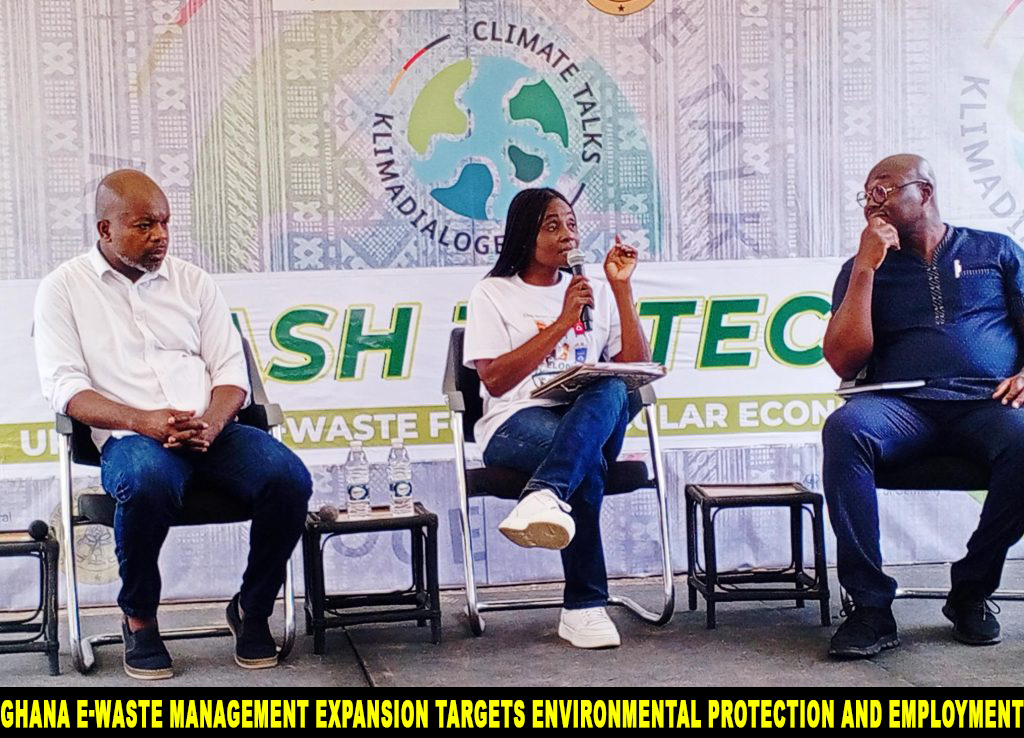
The Government of Ghana has announced plans to scale up electronic waste (e-waste) management nationwide as part of efforts to protect the environment, safeguard public health, and create sustainable jobs. The Minister of Lands and Natural Resources, Emmanuel Armah-Kofi Buah, said the rapid increase in the use of electronic devices across communities has made effective e-waste management a national priority. The initiative is expected to strengthen Ghana’s environmental sustainability agenda while opening new economic opportunities.
Why E-Waste Management Is Critical for Ghana’s Future
Speaking during an inspection tour of e-waste recycling facilities at the Ghana Atomic Energy Commission (GAEC) in Accra, Mr Buah warned that improper disposal of electronic waste could have serious environmental and health consequences.
With computers, phones and other electronic devices now common even in rural communities, the minister stressed that unmanaged e-waste could end up polluting drains, rivers and the sea, threatening ecosystems and human wellbeing.
Government Plans to Establish E-Waste Treatment Centres Nationwide
The minister outlined the government’s long-term strategy to build capacity for proper e-waste disposal across the country.
Key plans include:
-
Establishing e-waste treatment centres in all regions
-
Expanding facilities to every district assembly
-
Training local people in safe e-waste handling and recycling
-
Using e-waste management as a job creation tool, especially for the youth
According to Mr Buah, managing e-waste must become a core responsibility of local authorities to ensure sustainability.
Quotes and Official Remarks
Highlighting the urgency of the issue, the minister stated:
“Today, everybody in every village is trying to use a computer and have access to electronic systems. The question is how we dispose of the waste.”
He further warned:
“If we do not create the avenues for proper disposal, these wastes will end up in the sea, and the consequences are clear.”
Preventing Pollution Through Incentive-Based Recycling
The Team Lead for the Ministry of Environment’s E-Waste Project, Dr Vincent Kyere, explained that the initiative aims to eliminate harmful practices such as burning electronic cables to recover metals.
He noted that many scrap dealers resort to burning e-waste due to a lack of alternatives, causing serious air and environmental pollution. To address this, the project introduced an incentive-based system encouraging scrap dealers to deliver e-waste to designated collection centres.
Dr Kyere described the approach as urban mining, where valuable metals are recovered from discarded electronics instead of traditional mining.
Income Generation and Private Sector Investment
According to Dr Kyere:
-
Over 850 scrap dealers have registered under the programme
-
Participants are earning improved and more stable incomes
-
Private recycling companies are investing in machinery due to consistent material supply
Collection centres currently operate in Accra, Kumasi, Tamale and other locations, where materials are weighed, quality-checked and paid for before recycling.
Progress on Foundry Projects at GAEC
The Managing Director of Architectural and Engineering Services Limited (AESL), Gordon Tanga, provided updates on the Foundry Project at GAEC.
The project, which began in 2019, is designed to support local manufacturing by producing metal castings for:
-
Agriculture
-
Road construction
-
The shipping industry
He acknowledged that delays in settling outstanding invoices submitted in late 2024 had slowed progress but expressed optimism that the first phase would soon become operational.


I am extremely impressed with your writing skills and also with the layout on your blog. Is this a paid theme or did you modify it yourself? Either way keep up the excellent quality writing, it is rare to see a nice blog like this one today..