

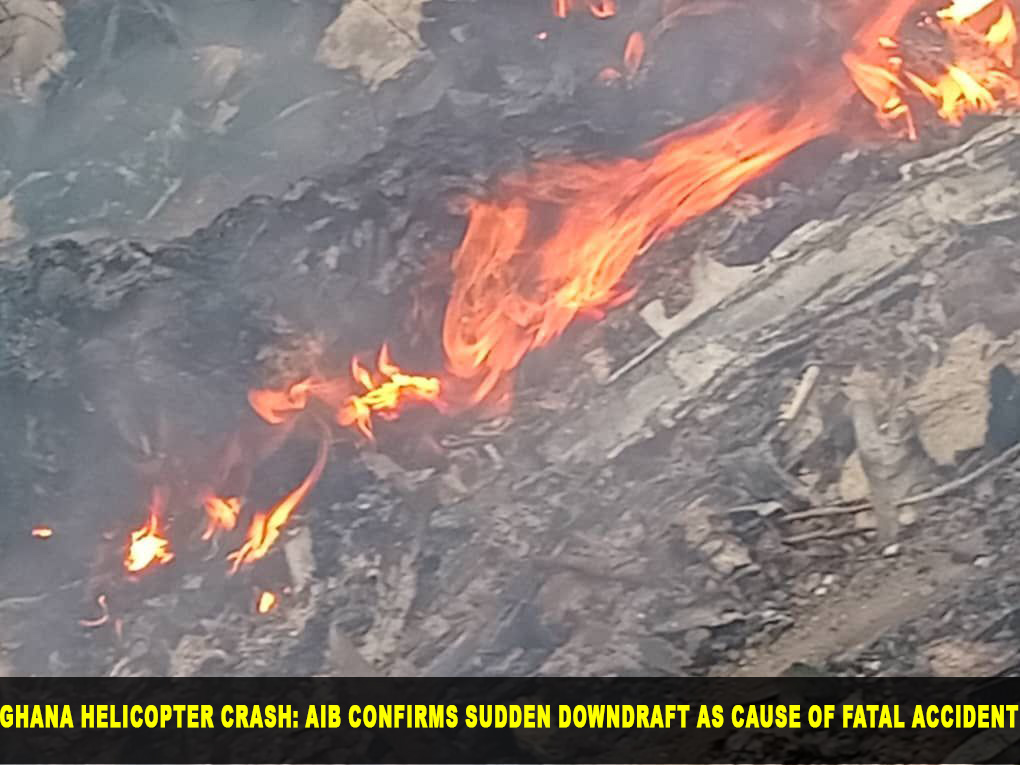
The Aircraft Accident and Incident Investigation and Prevention Bureau (AIB Ghana) has officially confirmed that a sudden and powerful downdraft caused the tragic helicopter crash that killed eight people in Ghana.
The final investigation report, presented on Tuesday, November 11, 2025, at the Jubilee House, closes the technical chapter on one of Ghana’s most devastating aviation disasters.
Technical Findings: Downdraft Led to Sudden Loss of Altitude
According to Captain Paul Forjoe, an investigator and retired pilot with AIB Ghana, the helicopter suddenly lost lift due to a strong downdraft — a rapid downward current of air that can overpower a helicopter’s ability to stay airborne.
“The investigation determined that the accident was caused by the sudden loss of altitude and lift due to downdraft,” Captain Forjoe explained.
He clarified that the downdraft occurred without any pilot error or mechanical failure:
“This loss of altitude without change in power or pitch attitude is consistent with downdraft associated with changing environmental conditions over high terrain.”
This means the pilot maintained correct control and power settings, but the powerful downward air current forced the aircraft down, making recovery impossible.
Environmental Factors Over High Terrain
The report highlighted how volatile weather conditions over elevated terrain can create dangerous air patterns. These sudden downdrafts, particularly in mountainous or forested regions, pose serious challenges even for experienced pilots.
The AIB Ghana emphasized that the crash underscores the risks of flying in areas prone to rapidly changing weather and turbulent air currents.
Background: The August 6, 2025 Tragedy
On August 6, 2025, a Ghana Air Force Harbin Z-9 helicopter carrying eight people crashed into a forested mountainside in the Ashanti Region, killing everyone on board.
The flight departed Kotoka International Airport in Accra at 9:12 a.m., en route to Obuasi Black Park for an event against illegal mining, before disappearing from radar.
When the wreckage was located hours later, all occupants had perished in a post-crash fire.
Victims of the Crash
The eight victims included several senior government and military officials:
-
Edward Omane Boamah, Minister of Defence
-
Ibrahim Murtala Muhammed, Minister of Environment
-
Limuna Mohammed Muniru, Acting Deputy National Security Coordinator
-
Samuel Sarpong, Vice Chairman of the NDC
-
Samuel Aboagye, Former Parliamentary Candidate
-
Sqn. Leader Peter Bafemi Anala
-
Flying Officer Twum Ampadu
-
Sergeant Ernest Addo Mensah
AIB Ghana’s Conclusion
The AIB Ghana’s final report brings technical closure to the investigation, ruling out both mechanical failure and human error.
Instead, it attributes the crash entirely to environmental forces, specifically a sudden downdraft—a natural but deadly aviation hazard.
The Bureau’s findings aim to enhance aviation safety protocols, ensuring pilots and operators are better equipped to identify and manage weather-related risks.


