

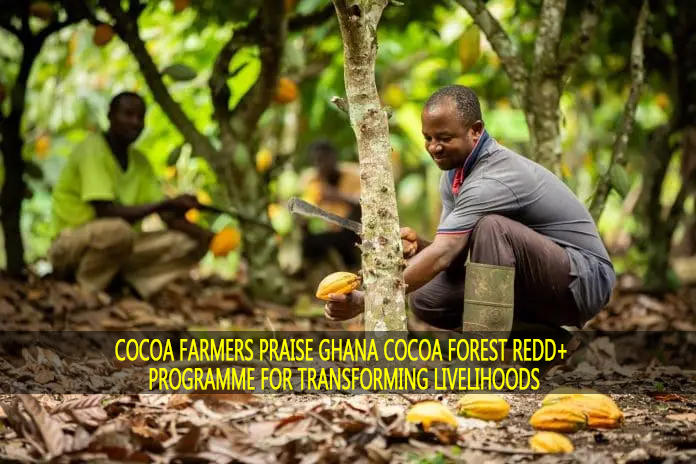
Cocoa farmers and residents in Ghana’s cocoa forest landscape have expressed strong appreciation for the Ghana Cocoa Forest REDD+ Programme (GCFRP), describing it as a life-changing initiative that has improved their livelihoods and boosted climate resilience.
The GCFRP, launched in 2019, is an emission reduction programme designed to incentivize smallholder farmers to adopt sustainable farming practices that protect forests and reduce carbon emissions. The programme aims to cut emissions by 40% within its 20-year lifespan (2016–2035) while improving cocoa yields and community wellbeing.
Programme Overview and Achievements
Implemented by the Forestry Commission’s REDD+ Secretariat, the GCFRP covers six key Hotspot Intervention Areas (HIAs) across the Eastern, Ashanti, Western, Western-North, and Central regions.
Since its inception, more than 560,808 smallholder farmers have adopted climate-smart agronomic practices that have:
-
Increased cocoa yields;
-
Reduced expansion of cocoa farms into forested areas; and
-
Lowered greenhouse gas emissions across cocoa-growing regions.
The programme has also attracted $21.8 million in carbon payments from the World Bank, with an additional $29 million pending disbursement for emission reductions achieved between 2022 and 2024.
Field Visits Reveal Strong Community Impact
A recent monitoring mission by the REDD+ Secretariat, the Global Landscape Forum (GLF), and the Daily Graphic revealed significant progress in the implementation of the GCFRP, especially in the Atewa HIA in the Eastern Region.
The delegation, which visited cocoa farms and alternative livelihood projects in Kyebi-Potroase and Wirenkyren Amanfrom in the Abuakwa South Municipality, observed visible improvements in both community infrastructure and agricultural productivity.
“The intervention has left giant footprints in the community and transformed the lives of farmers, ensuring sustainable farming,” one local farmer told the monitoring team.
Community Development and Climate Action
According to Collins Akonnor, Chairman of the Atewa HIA, the carbon funds have been judiciously used to support farmers and enhance local development.
He explained that:
-
58% of Atewa HIA’s funds went into agricultural inputs, including machetes, Wellington boots, motorized blowers, and 60,000 tree seedlings distributed to farmers;
-
39% was invested in community projects, such as boreholes, health facilities, and social infrastructure to improve the quality of life for residents.
“The carbon payments have truly made a difference — both for our environment and our livelihoods,” Mr. Akonnor said.
Building Climate Resilience Through Cocoa
The GCFRP represents a major milestone in Ghana’s efforts to balance economic development with environmental sustainability. By linking carbon finance to cocoa production, the programme not only incentivizes sustainable practices but also empowers local farmers to become key players in the fight against climate change.
Officials from the Forestry Commission emphasized that the initiative’s success demonstrates the value of community-based climate action, adding that continued international support will be critical to scaling up its impact nationwide.


Nhóm 4: Tập trung vào Trải nghiệm người dùng & Giao diện (20 đoạn) TONY02-03H